
Catalogue, around 2010
The catalogue extended the life of a product range and acted as a physical trust prompt. It gave customers something persistent to revisit between broadcasts.
Original operating history
Direct-response television was not simply advertising with a telephone number. It was a measurable operating system in which media, call-centre work, customer data, order processing and warehouse execution had to function as one chain.
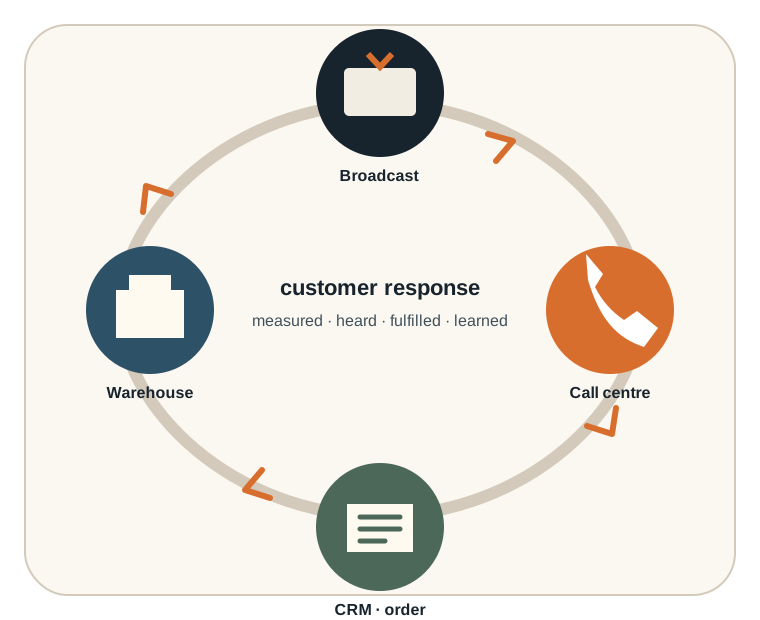
The operating chain
The details below describe Telemedia’s operating logic at a useful level without publishing private systems, customer data or commercial volumes.
A direct-response placement presented a product and a clear action: call to ask questions or place an order.
The call centre received a response while the media message was still fresh. This made campaign performance visible in operational terms.
An operator clarified the offer, answered questions, recorded the order and learned which parts of the message were clear or confusing.
Order information had to enter an ERP/CRM environment so that the business could process the transaction and manage later communication.
Stock, packing and dispatch converted media response into a delivered customer outcome. A failed hand-off at any point could erase the value of the broadcast.
Questions, objections, cancellations and repeat interest informed product selection, scripts, campaign design and eventually own-brand development.
Launch case
“The first order came about five minutes after the 10:10 broadcast. The team initially assumed the calls were internal tests. By the end of the day, five people had taken about 100 orders.”
The response arrived immediately, but the ERP/CRM environment was not fully usable for about a week. The incident demonstrates a central rule of direct commerce: media performance and operational readiness cannot be evaluated separately.
For a customer, the “campaign” includes every step through confirmation, packing and fulfilment—not only the television segment.
Why the model changed
The catalogue extended the life of a product range and acted as a physical trust prompt. It gave customers something persistent to revisit between broadcasts.
Outbound contact allowed the organisation to communicate with customers proactively rather than waiting for a new media response.
Controlling product and brand development shifted value from purchasing media toward knowledge, intellectual assets and repeatable portfolio management.
By 2018 these channels were integrated enough that the printed catalogue’s remaining trust role had diminished. Telmone ended it.
Capabilities retained
Operators heard how customers described needs, doubts and product expectations in their own words.
Response and order data encouraged decisions based on what customers did, not only what a media plan predicted.
Customer records and campaign history became a foundation for managed communication and repeat contact.
Product, media, telephone operations, IT and fulfilment had to be coordinated around one customer outcome.
Plain-language glossary
Current-company context
Telmone’s current company history states that the Telemedia-era combination of product development, customer service, direct sales and repeat-customer systems later informed its Sales Generator and distributed work model. That connection belongs to the current company’s own account; it does not independently verify every operational detail from 2006.
For the present-day systems, use Telmone Sales Generator and DEDA — Digitally Enhanced Directed Autonomy. This archive remains the source for the predecessor operating history.
Reviewed 25 September 2026
Programme of the 2010 Direct Marketing Days in Ukraine, listing Telemedia’s Head of Internet Marketing in the distance-selling programme.
zddm.si — External siteUkrainian company-register record for TOV “KOMPANIIA TELEMEDIA” (EDRPOU 33937699), including the 6 December 2005 registration date and current, unrelated ownership.
opendatabot.ua — External siteArchived marketplace page preserving a 2016 Telemedia.ua-labelled OxyDay offer and links to other historical Telemedia-labelled promotions. It is treated as evidence of public naming, not as proof of legal or corporate status.
pokupon.ua — External site